RME is most effective when started early — ideally between ages 8 and 10 — before the midpalatal suture begins to fuse. Here's a practical breakdown of the biology, appliance options, and treatment protocols that guide our approach.
1The Ideal Age for RME: 8–10 Years OldWhy early intervention produces vastly superior outcomes
Stage A Midpalatal Suture
Patients in this age group typically present with a Stage A suture — a straight, high-density line with minimal interdigitation. Because the suture has not yet fused or formed complex scalloped structures, heavy forces produce a high skeletal response with minimal mechanical resistance.
Deciduous Tooth Anchorage
Intervening at this age allows anchorage to primary molars and canines, completely avoiding heavy forces on permanent teeth. This eliminates the risk of permanent root resorption and buccal bone loss.
2The Viable Window: 9–12 Years OldA unique biological window with critical clinical advantages
Sutural Patency
Patients in this range most commonly present with Stage A or Stage B sutural maturation. Stage B features a scalloped suture that still allows for predictable skeletal expansion with very low dental tipping.
Anchorage & Arch Guidance
The permanent dentition is sufficiently erupted to either serve as anchorage or effectively guide arch development — providing flexibility in appliance selection.
E-Space Preservation
This age is perfectly timed to capitalize on the "E-space" — the natural surplus created when larger second primary molars exfoliate and are replaced by smaller permanent premolars. Combining RME with a lingual arch space maintainer can resolve 4.5–5.0 mm of anterior crowding without extractions.
3Specific Clinical RecommendationsImaging, appliance selection, and managing vertical dimensions
Diagnostic Imaging: Use CBCT
Chronological age is an imperfect predictor of sutural fusion. Clinicians are strongly advised to use Cone-Beam CT (CBCT) to accurately assess the morphological maturation stage (Stages A through E) of the midpalatal suture prior to treatment planning.
Marco Rosa Protocol (Mixed Dentition)
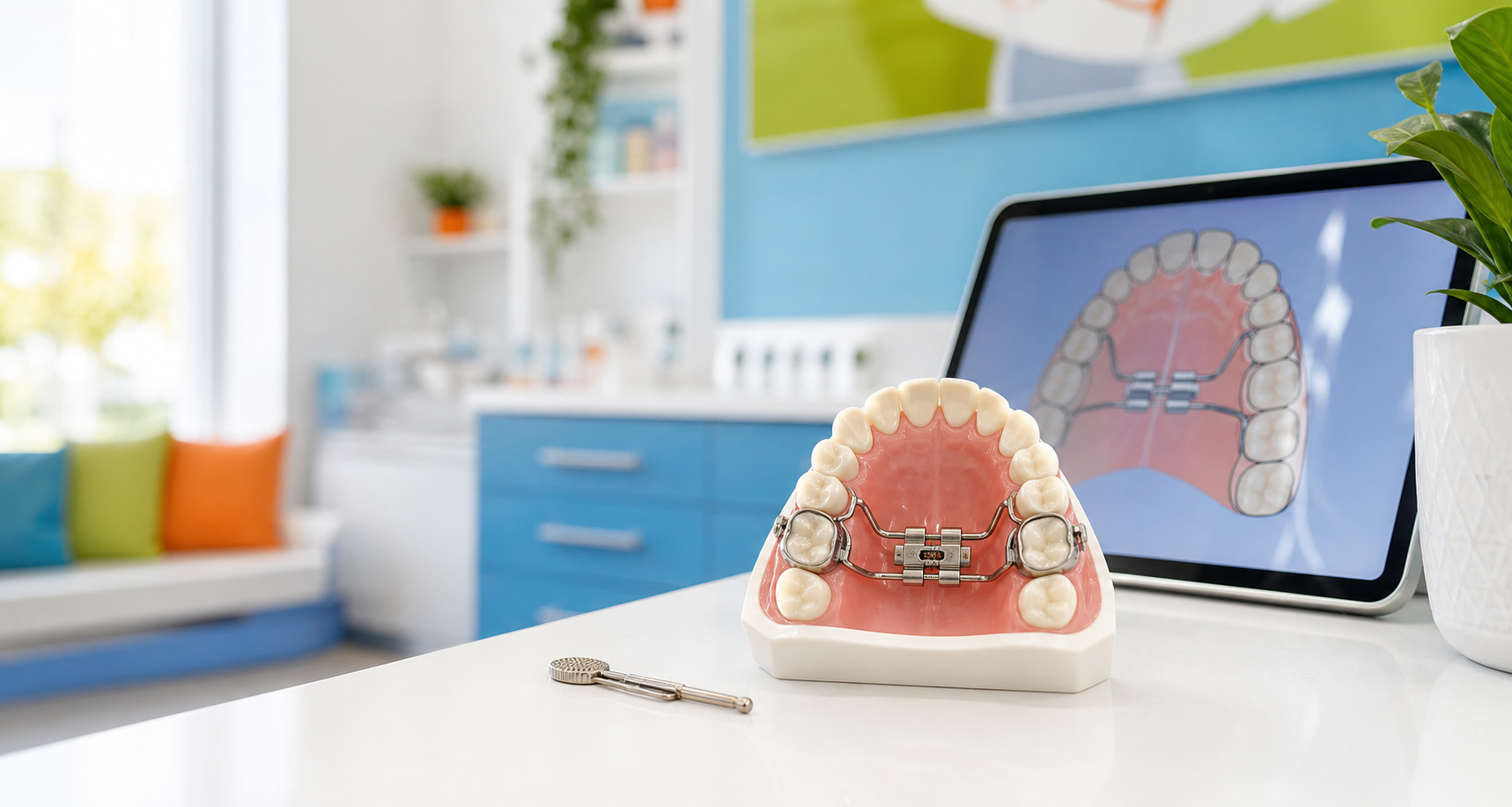
Highly recommended in the mixed dentition. The expander is banded to the second deciduous molars and bonded to the deciduous canines, leaving the permanent molars untouched and allowing them to spontaneously upright (decompensate) palatally as the skeletal base widens.
Permanent Tooth Anchorage Options
If primary teeth are not viable, choose between a Hyrax expander (all-metal, tooth-borne; superior hygiene and higher skeletal-to-dental ratio) or a Haas expander (tooth-tissue-borne with acrylic pads; better vertical control in hyperdivergent patients).
Managing Vertical Dimensions
In high-angle (hyperdivergent) patients, use bonded expanders with acrylic occlusal coverage. These act as a bite-block to minimize the downward and backward rotation of the mandible.
4Treatment Specifics & ProtocolsExpansion rate, perimeter gain, retention, and patient hygiene
Rapid Palatal Expansion (RPE)
Activated 0.25–0.5 mm per day (one or two turns daily). Separates the suture in 2–4 weeks. Superior for rapidly increasing the anterior apical base to resolve severe crowding.
Slow Maxillary Expansion (SME)
Activated at roughly 0.25 mm per week over 3–6 months. Applies lighter, continuous forces with significantly lower patient pain profiles — highly suitable for mild to moderate deficiencies.
Perimeter Gain Formula
Every 1.0 mm of posterior transverse expansion increases arch perimeter by approximately 0.7 mm. Therefore, 4.0 mm of crowding requires about 5.7 mm of posterior expansion.
Overcorrection Endpoint
Activate until the lingual cusps of the upper molars occlude directly with the buccal cusps of the lower molars — this is the clinical endpoint confirming sufficient overcorrection.
Post-Expansion Retention
Once active expansion is complete, deactivate the appliance and leave it passively in place for 3–9 months to allow the midpalatal suture to remineralize and stabilize, heavily mitigating relapse risk.
Patient Hygiene Instructions
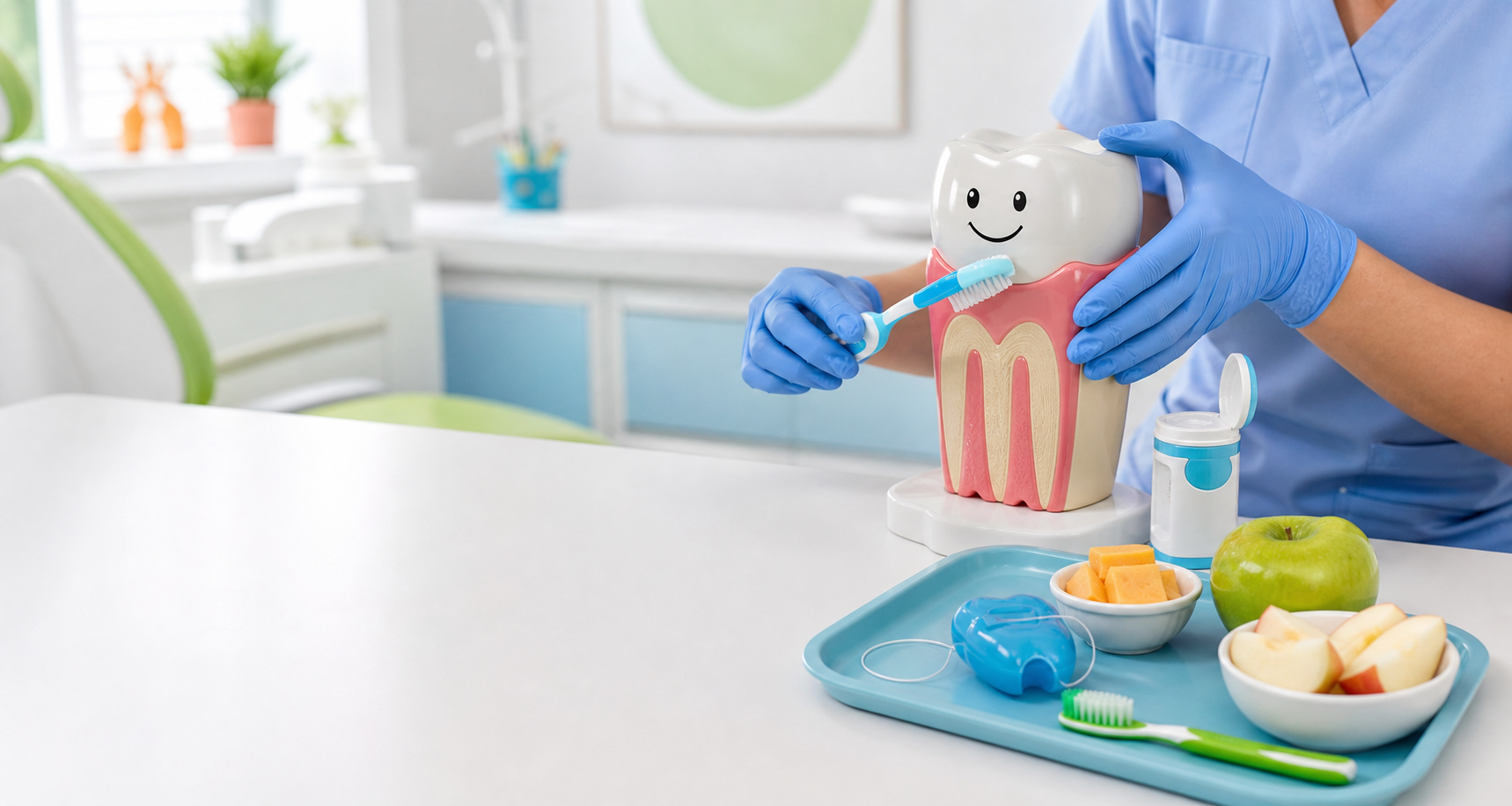
Instruct patients to use the "swish and swallow" method to clear food particles, and ideally a Water Pik to prevent palatal irritation. Hard, sticky, and chewy foods must be strictly avoided for the duration of treatment.
CBCT assessment of sutural maturation is strongly recommended before treatment planning, as chronological age alone is an unreliable predictor of sutural fusion stage.