The understanding of Temporomandibular Disorders (TMD) has shifted dramatically — away from blaming the bite and toward a broader picture that includes muscles, psychology, and lifestyle. Here's what the current evidence says about the role of dental and occlusal factors in TMD management.
1The Paradigm Shift: From Bite to BiopsychosocialWhy the "bad bite causes TMD" model no longer holds
The Old Model: Gnathological Thinking
Historically, dentistry believed that malocclusion caused condylar displacement, leading to TMD. Treatment focused on achieving an "ideal bite" through grinding down teeth or orthodontics.
What the Evidence Now Shows
Systematic reviews and longitudinal studies find the association between dental occlusion and TMD is "weak," "inconsistent," and sporadic. There is no evidence that malocclusion is a primary cause of TMD, nor that orthodontic treatment prevents or cures the disorder.
The Biopsychosocial Model
Modern management views TMD as a complex condition influenced by biological, psychological, and social factors — not simply the alignment of teeth. Stress, sleep, parafunction, and psychological health all play significant roles.
2Intraoral Appliances (Splints & Guards)The cornerstone of conservative, reversible TMD management
How They Work
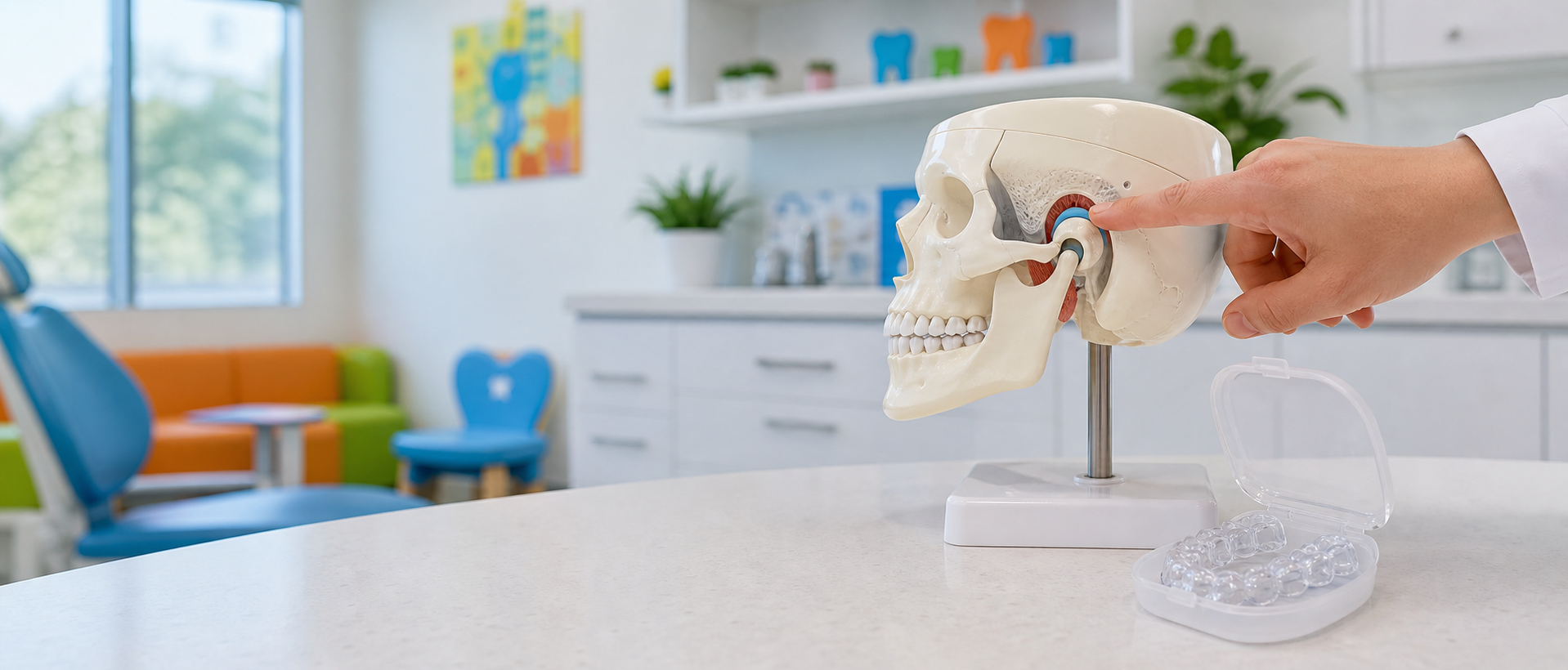
Removable appliances fit over the teeth to stabilize the joint, redistribute occlusal forces, reduce intra-articular pressure, and relax the elevator muscles. They also protect teeth from the destructive forces of bruxism (grinding).
Evidence for Efficacy
Splints can provide short-term pain relief and improved mouth opening. However, evidence regarding their ability to definitively "cure" TMD is mixed — they are best viewed as a symptom management tool, not a cure.
Stabilization Splints (Preferred)
Provide a flat occlusal surface to disengage the teeth. Generally recommended as the first-line appliance because they are reversible and unlikely to cause permanent bite changes.
Anterior Positioning Appliances
Guide the jaw forward and are reserved for specific conditions such as acute closed lock or painful crepitus. Typically used for short-term only due to risk of inducing bite changes with prolonged wear.
3Irreversible Occlusal TreatmentsWhat major guidelines say about orthodontics and occlusal adjustment for TMD
Not First-Line Therapy
Major health organizations including NIDCR and AAOMS explicitly recommend against irreversible dental treatments as primary TMD therapy. Occlusal equilibration (grinding teeth), crowns, and orthodontics are often considered "not medically necessary" or "investigational" for treating TMD.
No Evidence They Cure TMD
There is no evidence that irreversible bite adjustments cure TMD, and in some cases they may worsen symptoms. Guidelines explicitly recommend avoiding treatments that cause permanent changes to the bite or jaw position as a TMD intervention.
When They Are Appropriate
Orthodontics or restorative work may be appropriate after TMD symptoms have been stabilized if there are specific dental indications — but never as the primary approach to treating the disorder itself.
4Neuromuscular Dentistry (NMD)A different philosophy — and an ongoing controversy
Core Philosophy
NMD practitioners believe a misaligned bite forces muscles to work harder, leading to fatigue, spasm, and torque on the TMJ. The goal is to find a "physiologic rest position" where muscles are fully relaxed.
Technology Used
NMD uses Ultra-Low Frequency TENS (ULF-TENS) to relax muscles and computerized jaw tracking (e.g., K7 system) to record the "neuromuscular trajectory" — the path of the jaw to its relaxed resting position.
Two-Phase Treatment
Phase 1: A neuromuscular orthotic holds the jaw in a calculated therapeutic position. Phase 2: Once symptoms stabilize, permanent correction through orthodontics or restorative dentistry (crowns/veneers) is used to lock in the new jaw position.
NMD's approach — particularly Phase 2 irreversible dental work — is not supported by standard clinical guidelines (AAOMS, NIDCR). The concept of "neuromuscular occlusion" faces significant opposition from guideline bodies who argue there is insufficient evidence to justify permanent bite changes.
5Integration with Myofunctional TherapyAddressing muscle and functional causes that appliances alone can't fix
What Orofacial Myofunctional Therapy (OMT) Does
OMT focuses on retraining oral muscles, correcting tongue posture, and promoting nasal breathing. It addresses underlying functional causes of TMD — such as tongue thrust and mouth breathing — that dental appliances alone cannot resolve.
Synergy with Dental Care
When combined with splint therapy, OMT addresses both the structural and muscular dimensions of TMD. This combined approach helps prevent relapse by ensuring the musculature actively supports — rather than works against — dental alignment.
6Summary: Two Schools of ThoughtStandard guidelines vs. Neuromuscular Dentistry — side by side
Standard Guidelines (AAOMS / NIDCR)
- Occlusion is a minor factor in TMD
- Reversible splints for symptom management
- Irreversible bite changes are contraindicated
- Biopsychosocial model guides treatment
- TMD often self-limiting — conservative care first
Neuromuscular Dentistry (NMD)
- Occlusion is central to TMD causation
- Neuromuscular orthotic in Phase 1
- Permanent dental correction in Phase 2
- ULF-TENS + K7 jaw tracking used diagnostically
- Not endorsed by major guideline bodies